
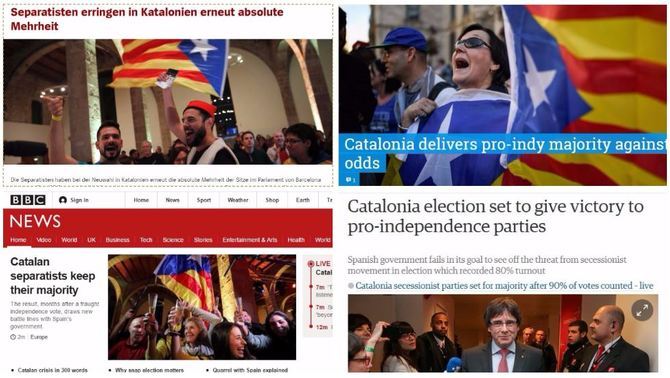
Photo: excerpts from international media coverage of the Catalan elections on the 22nd of December
The parliamentary elections in Catalonia were closely monitored by the international media.
CNN highlighted that the support for the pro-independence parties represents a defeat for the strategy of the Spanish government:
Voters in the Spanish region of Catalonia have backed pro-independence parties in elections, dealing a blow to Spain’s hopes of quelling separatist sentiment in the region https://t.co/sqho6AizfQ pic.twitter.com/tqjhwJIHS1
— CNN (@CNN) 21 December 2017
The New York Times explained that the results demanded a reversal of fortunes for Mariano Rajoy:
Catalonia’s separatist parties were poised to hold on to a narrow majority in regional elections, according to nearly complete official results https://t.co/e52NXWhNC8
— The New York Times (@nytimes) 21 December 2017
Russia Today and France Press pointed out that the absolute majority of the pro-independence parties was again validated:
Pro-independence parties again secured absolute majority in the #Catalan parliament https://t.co/1mRTx06av8 pic.twitter.com/U023iwFI3t
— RT (@RT_com) 21 December 2017
#BREAKING Catalan separatists set to win back absolute parliamentary majority, according to a partial official count pic.twitter.com/CzkAW0NZaE
— AFP news agency (@AFP) 21 December 2017
The Independent highlighted that the result was a “victory” for Carles Puigdemont’s party:
Party of Carles Puigdemont claims victory for independence movement in Catalan election https://t.co/pFpvoUH3wi pic.twitter.com/UGExrCW7sz
— The Independent (@Independent) 21 December 2017
The Guardian also underlined that the victory of the pro-independence parties represents a disaster for the Rajoy government’s strategy, in this article.
In the German “Der Spiegel”, the headline article was that the pro-independence parties returned yet another majority.
Laut Wahlbehörde: Separatisten erringen in Katalonien erneut absolute Mehrheit https://t.co/qeR3jIn3MB pic.twitter.com/sbkr1lJKPE
— DER SPIEGEL (@DerSPIEGEL) 21 December 2017
The press agency Reuters indicated that Puigdemont had recouped control, and put Rajoy on the back foot.
Catalan separatists on track to regain control of parliament https://t.co/kXgvGQ0LiG
— Reuters World (@ReutersWorld) 21 December 2017
The Wall Street Journal wrote that Catalan independence parties had won a “transcendent” election.
Relations between Catalonia and Madrid are in for another period of uncertainty after separatists win a majority in regional vote https://t.co/6CuS8HQVy5
— The Wall Street Journal (@WSJ) 22 December 2017
The headline of the “Corriere della Sera” referred to an “Pro-Independent Absolute Majority”:
Catalogna, riscossa degli indipendentisti: hanno la maggioranza assoluta Foto https://t.co/38NVYFWJhP pic.twitter.com/x77ET3UCRm
— Corriere della Sera (@Corriere) 21 December 2017
Some media, like The National, a Scottish newspaper openly in favour of Catalan and Scottish independence, announced the election results with a sneak-peek of their Thursday front page:
Tomorrow’s front page … Visca Catalunya! World Exclusive: Final poll has vote on a knife-edge with pro-indy parties just winning narrow majority pic.twitter.com/YQtxpO8H2e
— The National (@ScotNational) 20 December 2017
Other media outlets tracked the results minute-by-minute. “Le Monde” created the #catalogne hastag, and the British BBC offered up images like this one:
With 30% of votes counted, separatist parties are on course to win an absolute majority in the new Catalan parliament
Latest live: https://t.co/B2MMH1NUEX pic.twitter.com/ADRPeB3vfn
— BBC News (World) (@BBCWorld) 21 December 2017
On Sky News the highlight was a “victory for Puigdemont”.
Live updates here as pro-independence parties look set to win a clear majority of seats in the new Catalan parliament https://t.co/9PEKU0caFG
— Sky News (@SkyNews) 21 December 2017
“Libération” also highlighted the independence majority:
Catalogne : participation record, l’issue du scrutin encore indécise https://t.co/kmbyjX0yQG pic.twitter.com/CQE1itUlRe
— Libération (@libe) 21 December 2017
The pro-independence majority was also headline news in the Financial Times:
Breaking News: Pro-independence parties in Catalonia are on track to win an absolute majority of seats in regional elections held on Thursday https://t.co/itKlCfChEW pic.twitter.com/DFysMfdXqb
— Financial Times (@FinancialTimes) 21 December 2017
The TV channel BMFTV summed up that the pro-independence parties gained 70 seats of the 135 available, despite the most votes for a single party going to Ciutadans (Citizens Party).
Catalogne: les indépendantistes majoritaires selon des résultats partielshttps://t.co/cKFcwoerry pic.twitter.com/4U7ZsPcAEk
— BFMTV (@BFMTV) 21 December 2017
When the counting was nearly complete, prognoses and questions were raised. The writer and journalist Tim Parfitt, a correspondent for The Weekly News, went on to ponder if President Rajoy should resign:
From what I see, after 71% of votes counted, the pro-independence parties are going to maintain a majority with 70 seats. After trying to prevent the 1-O referendum, after 155, after locking up politicians, the “issue” is still there. So what next for Rajoy? Should he resign?
— Tim Parfitt (@tjparfitt) 21 December 2017
One of the first media to give near-definitive results was Politico magazine:
Catalan separatists are on course to retain their absolute parliamentary majority — a blow to Madrid https://t.co/3QOyyRv9j2
— POLITICO Europe (@POLITICOEurope) 21 December 2017
Over and above the results, the Qatari outlet Al Jazeera disseminated an opinion piece by political scientist Jason Sorens, entitled “Cracking down on independence movements is a bad idea.” On their Twitter an idea that might seem surprising was highlighted:
Civil war did not follow Catalonia’s declaration. Here’s why suppressing independence movements is not a solution https://t.co/PTdydXW3KH #AJOpinion pic.twitter.com/qAURWnQXJY
— Al Jazeera English (@AJEnglish) 21 December 2017
Sorens was basically arguing two ideas. The first being that “it is impossible to erase the idea of independence from minds”. And the second, that “when governments try to eliminate the possibility of independence, they give themselves free hands to mistreat their ethnic minorities.” And he cited the conclusions of one of his studies:
“My research shows that democracies that define themselves as “indivisible” in their constitutions are less likely to decentralise power to their regions and give more rights to local communities to govern themselves.”
Original link: http://www.ccma.cat/324/unanimitat-a-la-premsa-internacional-lindependentisme-torna-a-tenir-majoria/noticia/2828094/#