
By ACN (Catalan News Agency), Girona – 25 October 2017
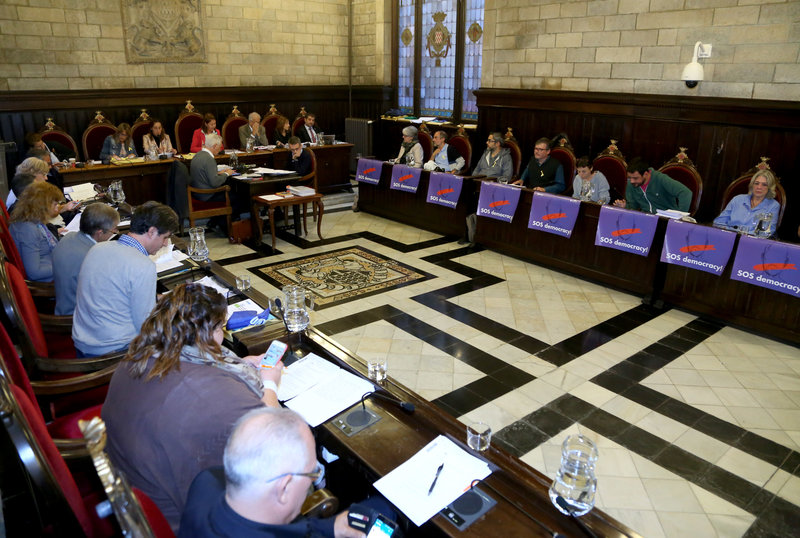
A plenary of the city council of Girona has declared King Philip VI of Spain ‘persona non-grata’ and voted by majority to reject the application of article 155. The political conflict between Catalonia and Spain, aggravated after the referendum of October 1st, has become a key topic in the town hall, where four motions were debated in a single session. The four demands were: stop the intervention into autonomy, ask for the liberation of the Jordis, condemn the “police repression” that was experienced on 1-O and declare the delegate of the Spanish state, Enric Millo, ‘persona non-grata’. One of the motions, jointly presented by ERC (Republican Left) and the CUP (People’s Unity Candidacy – anti-capitalist party), also extended the rejection of the city to the Spanish monarch. When voting on this point, the Socialists abstained. But seven councilors supported the motion, together with CiU (Convergence & Union party), ERC and the CUP. They also supported the text which urges the State to stop the application of article 155 and supports the Catalan Parliament to “act on the mandate” of the 1st of October.
Three of these motions voted upon in the plenary were promoted and proposed by the AMI (Association of Municipalities for independence) and the ACM (Catalan Association of Municipalities and Counties). The fourth – which included declaring the monarch ‘persona non grata’ – was presented jointly by ERC and the CUP.
Both groups have tried previously, in the July plenary session, to reject the Bourbon [King Felipe VI]. Back then, however, the motion did not pass, because CiU voted against it. This time, especially after the king’s speech after the events of the 1st of October, the CiU supported it.
The four motions were jointly debated, although they were voted upon separately. The CUP councilor, Lluc Salellas, was first to speak, and criticized the “abhorrent and totalitarian repression” on the part of the State and called the PP (ruling People’s Party) delegate in Catalonia, Enric Millo, a native of Girona, “persona non-grata” for “having sent hundreds of police officers to beat people who defended ballot boxes and democracy”.
Salellas also said that the application of 155 would mean that “Catalonia is once again subject to the powers of the empire” and turn the clock back decades, “as far back as 1975 or possibly even 1955.” And at this point, he asked that the Socialists “not endorse the application of 155”.
ERC spokeswoman, Maria Mercè Roca, recalled that “whoever uses force and violence has already lost”, referring to the position of the State. In contrast, Roca pointed out “the dignity of the Catalans”, which makes them “free” and “distanced from a regime that lies, manipulates and wants to annihilate Catalonia.” The Leftist Republican spokeswoman also criticized the role of King Felipe VI, for having “thrown the Catalans under the hooves of horses” instead of protecting them.
“We will never forget”
The spokesman for CiU, Carles Ribas, recalled that Girona “will never forget” the events of 1-O (first of October). “What they did is unforgivable,” he said. For this reason, Ribas guaranteed to vote in favour of declaring both Millo and Felipe VI ‘persona non-grata’ for allowing “a mistake as serious as physical attacks on people” and because the monarch, during his speech, “further reinforced the attitude of the now infamous ‘a por ellos’ [go get ‘em!’] slogan.”
The CiU spokesman also criticized the State for treating those who participated in the referendum “like animals”, and said that the application of 155 is “a monster” that will “bring us back to the times of dictatorship” whilst also criticizing the imprisonment of Cuixart i Sánchez [leaders of civil society organisations ANC and Omnium). “They expatriated them and took them away from home,” he said.
“On the margins of legality”
The speeches of PPC (ruling People’s Party Catalonia) and Ciutadanos Party spokespersons were in sharp contrast to the previous ones. The PP councilor Concepción Veray argued that “democracy is respect for laws” and argued that, although “no one enjoyed” 1-O the Spanish police and the Civil Guard merely complied with “judicial orders”.
Veray also said that the current situation in Catalonia is down to “a single guilty party”, pointing directly at the President of the Generalitat, Carles Puigdemont. “Therefore, if someone ought to be declared non-grata and be asked to resign, it is him,” she said.
Finally, the PPC spokeswoman said that the state had exhibted “a grand patience” before applying 155, asserted that peaceful coexistence in the city of Girona “has been broken” and criticized the mayor, Marta Madrenas, “for having taken up a megaphone and faced Spanish police at the front of a manifestation of people” (referring to the night in which the City Council tried to denounce the State).
For her part, the spokesman of Ciutadanos, Míriam Pujola, said that October 1st it was “a sad day for Spanish democracy.” Pujola also asserted that her party “has long warned that nationalism, which is the corrupt network and client-state of Catalonia, was empowering the public institutions.”
The Ciutadanos spokeswoman also asserted that the conflict between Catalonia and Spain is “an internal affair” and called for autonomous elections to be undertaken. “Only in this way will Parliament have a legality in which to dialogue,” she said.
“Catalan and Socialist”
The PSC (Catalan Socialist Party) spokeswoman, Sílvia Paneque, began her address by saying she felt both “Catalan and Socialist”, and criticized the State for piling “greed upon failure.” Paneque, however, recalled that this is not “a conflict between good and bad”, also blaming the Catalan government for having forced through the Parliament’s new bills on 6 and 7 September (when the referendum law and the law of legal transition were both passed).
“Those who do things badly cannot justify calling others worse,” she said. And here, Paneque went on to lament that in all the motions brought to the, the same formula had been used: a mix of points with which the Socialists “agreed fully” and others which they “could not agree”.
Before voting, Paneque summarized the intentions of the votes of her councilors. “We are against 155 in any case, but we are not pro-independence; We hate that Jordi Sánchez and Jordi Cuixart have been jailed, but we do not believe that it contributes anything positive to say that those who do not vote in favour of this motion are accomplices of a dictatorship”, she said. And She concluded: “This is where we find ourselves today, and we would have liked it for be different.”
“You will find we stand up to you”
Before moving to the vote, the mayor of Girona, Marta Madrenas, took the floor to state that since 1-O, Catalans have “lost their fear”. Madrenas, speaking directly to Veray, said that the population will “never forget” the “physical and judicial violence that the PP government has carried out” and emphasized that when it comes to applying article 155, they will find “we Catalans stand up to you”.
The three motions promoted by the AMI and the AMC received the same support (that of CiU, PSC, ERC and the CUP) and the same votes against (those of Ciutadanos and the PPC). In the case that the suspension of article 155 was not possible, the draft motion also supported a Universal Declaration of Independence by Parliament (DUI). The Socialists voted in favour of this; despite Paneque having made the position of their party clear (and it was for this reason they did not first make it public).
In the motion proposed by ERC and the CUP, in which it was proposed King Felipe VI be delcared a ‘persona non-grata’, support came from CiU, and the Socialists abstainted. The PPC and the Ciutadans councilors voted against.